A Rust integration layer between MCP-compatible clients and a PLOMID database: discover the tools, inspect the schema, run bounded SQL, and keep the database independent the whole way.
The adapter is the only database boundary. It neither bundles nor replaces PLOMID.
Status
Where PLOMID-MCP stands today.
PLOMID-MCP is implemented, tested and documented, but no tagged release has been
published yet. It connects to a separately deployed PLOMID database: it does not bundle
the engine, read storage files or replace the system of record. Read-only mode is the
default; controlled writes follow a separate, approval-gated path.
Rust, speaking the Model Context Protocol over STDIO or Streamable HTTP.
Connects to
An independently running PLOMID database over its supported SQL protocol.
Exposes
Eight tools and one prompt in the standard configuration. A ninth controlled-write tool appears only when writes are explicitly enabled.
State today
Working source tree with unit, integration and transport tests. The release workflow is configured for six native targets; no tagged release has been published yet.
Download
Download
Take the build for your machine.
The release workflow is configured to build native packages for six targets: Linux and
macOS tarballs, Windows zips. Packages appear on GitHub Releases when a version tag is
pushed. Source archives and the source installer work now.
release matrix6 native targetsRelease status on GitHub
Packages carry the executable, example configuration, license notices, CycloneDX SBOM and a
SHA-256 checksum. They appear on the release page when a version tag is pushed. The release
workflow is configured for all six targets; no tagged release has been published yet.
Source
Build the same source locally for the target above.
The server is a protocol adapter, not a database replacement. Tools and prompts are
served by the MCP process; SQL and database authorization remain at the database
connection boundary.
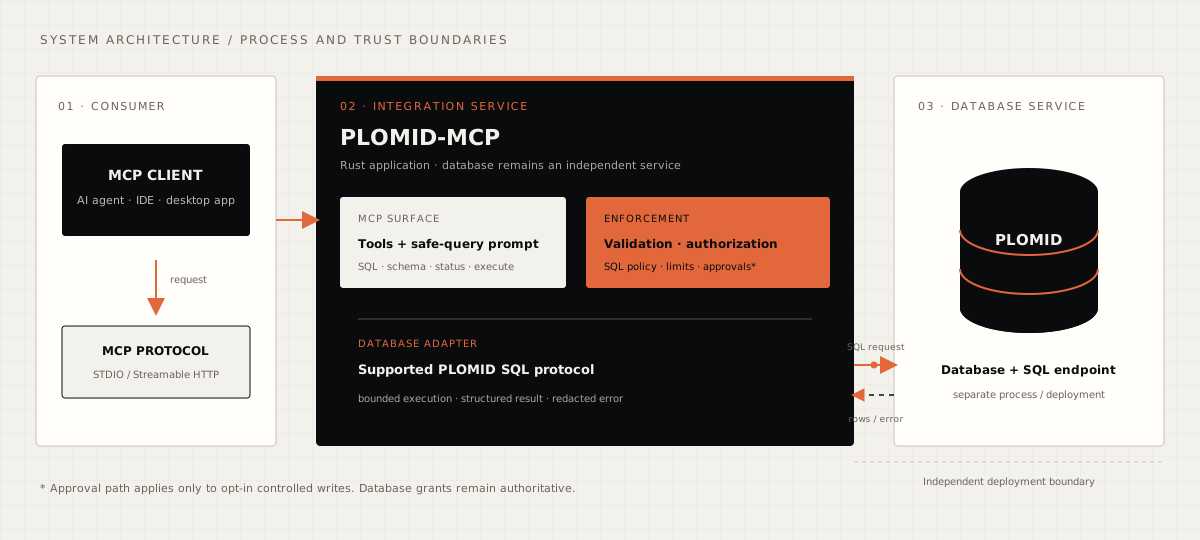
The product's architecture drawing: consumer, integration service and database service.
MCP consumerThe client discovers tools, chooses one and supplies arguments. It receives bounded structured content, never credentials or a raw backend error.
Integration servicePLOMID-MCP validates arguments and applies the policy, authorization, SQL and resource checks that belong to that operation.
Database servicePLOMID runs independently. Database roles remain the final privilege boundary even when application-level controls are configured.
Tool surface
What a client can call.
Eight tools in the standard configuration, plus one prompt that guides a client through
a safe query workflow. The ninth tool, controlled SQL execution, is advertised only
when the server is configured for it.
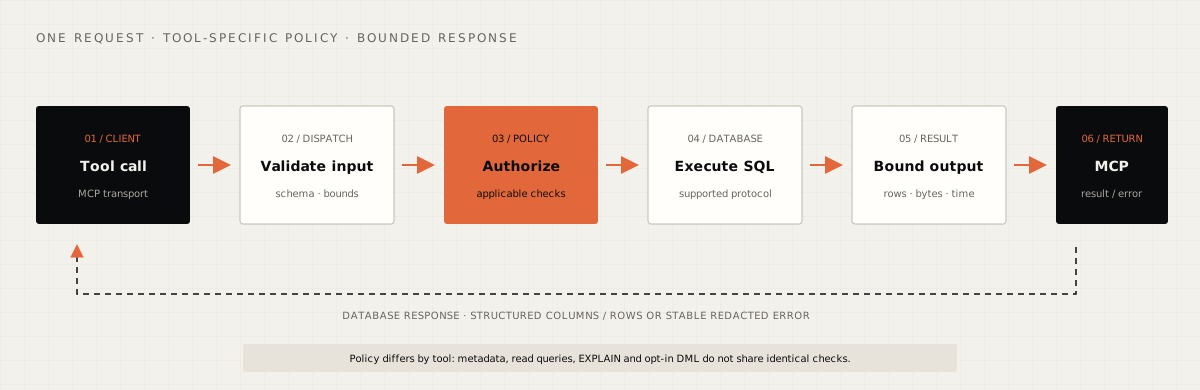
Status and capabilities report state. Metadata tools inspect visible objects. SQL tools
are parsed and bounded. The write tool has additional approval checks. Those paths do
not share identical policy, on purpose.
One request, tool-specific policy, bounded response — drawn from the repository.
Query defaults
100 rows and 10 seconds per request.
Tool limits
Requests clamp to 1–10,000 rows and up to 120,000 ms; process-wide caps apply after that.
Statement limits
256 KiB SQL, up to 64 parameters, each up to 64 KiB.
Result limits
Rows and encoded bytes are capped. A truncated result says so instead of silently shrinking.
Write limits
One permitted DML statement only. Administrative, transaction and multi-statement SQL are not part of the write workflow.
Security model
Read-only by default. Writes are explicit.
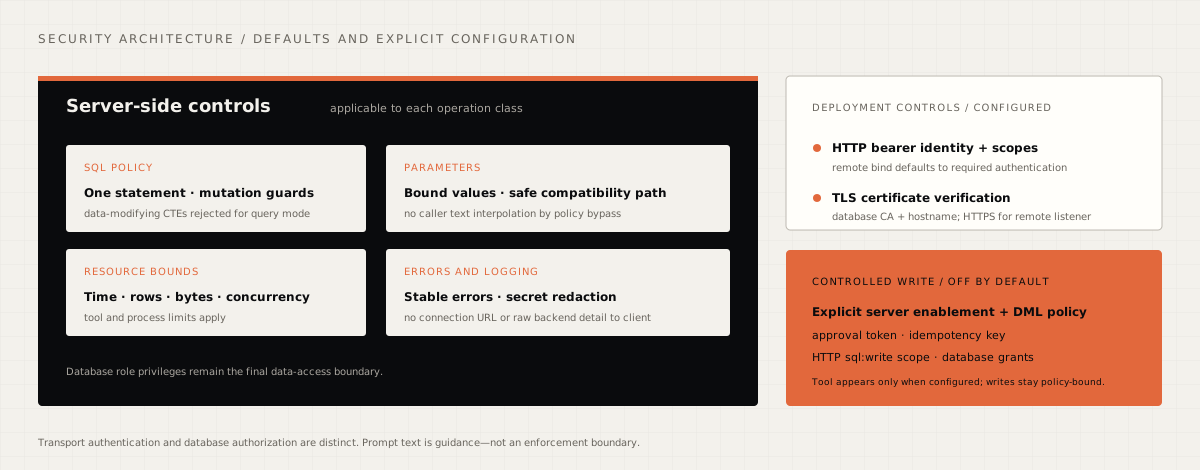
Parser-backed SQL policy, bounded parameters and results, redacted errors and
configurable deployment controls apply to the paths they govern. Controlled writes are
off until the operator turns them on.
Defaults, deployment controls and the opt-in write path. Database grants remain the
final data-access boundary.
One statement
Read tools reject mutations, administration, transactions and data-modifying CTEs.
Parameter values use protocol binding where supported.
Controlled writes
Require controlled-write mode, an approval token digest, an idempotency key, permitted
DML, the HTTP write scope where applicable, and database write grants.
Database is decisive
Application controls do not replace PLOMID roles, TLS verification, network
segmentation, secret rotation or host hardening.
Deployment
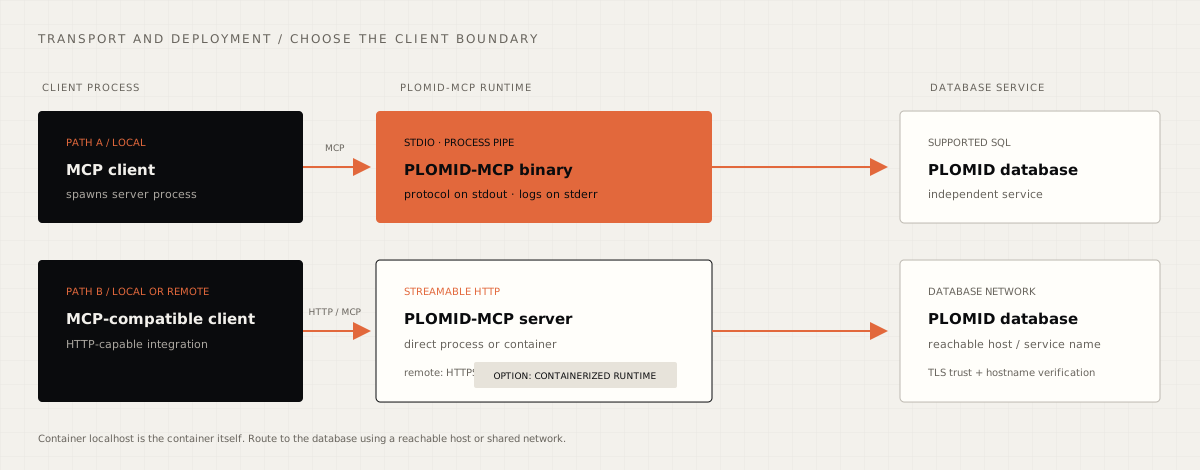
Local process or listening service.
STDIO is launched by the client; Streamable HTTP listens for local or networked clients.
Either can run directly or in a container, and every path connects to an independent
PLOMID database.
Two transport paths, one database boundary. Remote HTTP requires TLS, allowed hosts and
origins, and bearer identities.
Keep the raw database URL in the client's protected environment or secret store, not
in a committed file. Replace the path, URL and placeholders.
Scope
What this preview does not claim.
Application controls do not replace database roles, TLS validation, network segmentation,
secret rotation or host hardening. A passing unit test does not prove the absence of
vulnerabilities. Live database authentication, cancellation, external conformance,
independent client compatibility and cross-platform runtime support still have to be
validated in the release environment before enterprise GA.
The product's own documentation holds the exact tool contracts, configuration reference,
security model and operations runbooks.
Next
Give an agent a governed way in.
Start with a read-only connection to an isolated database, discover the tools, and
inspect the shapes a client can actually see. Controlled writes come later, and only
when the environment is ready for them.